> For the complete documentation index, see [llms.txt](https://guide.hardfin.com/llms.txt). Markdown versions of documentation pages are available by appending `.md` to page URLs; this page is available as [Markdown](https://guide.hardfin.com/manage-your-account/organization/user-management.md).
# User management
Organization **users** are people that are members of your organization. The user list is visible from the organization page. Organization administrators can make updates to each user.
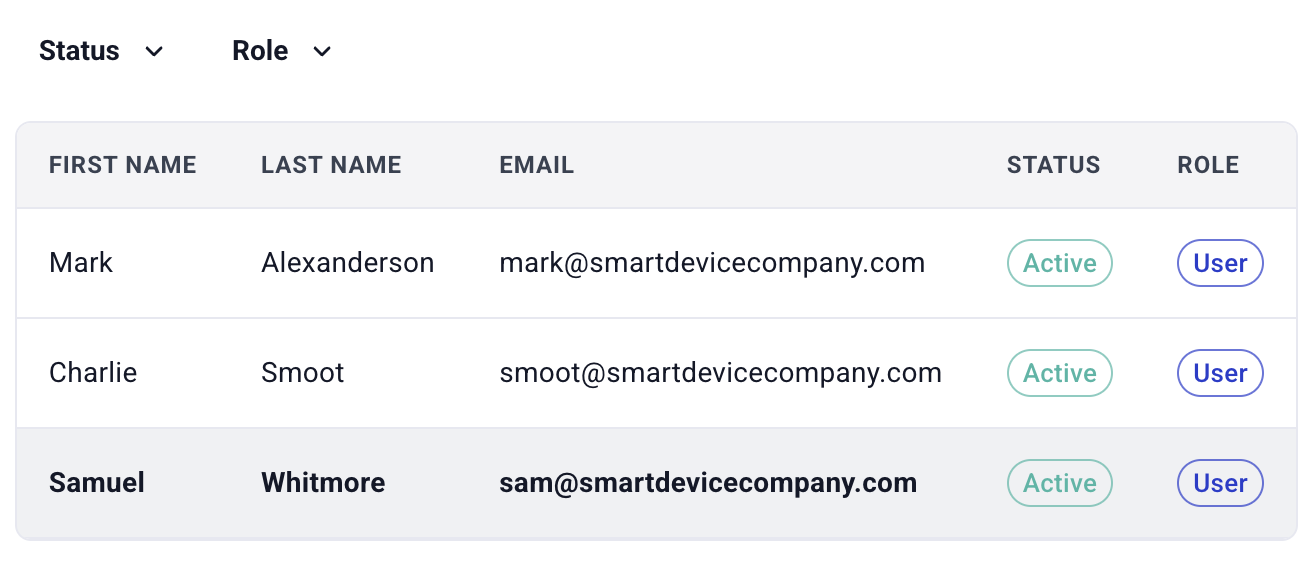
User information includes first name, last name, email, status (active or deactivated), and role (user or administrator).
User list view
The **most recent dates** when users were updated are available by hovering on the user's current Status or Role.
{% hint style="info" %}
See the advanced options for more information on [permissions and roles](/advanced-options/permissions.md).
{% endhint %}
## Additional options for administrators
Administrators will see additional options for each user to change their status and role, as well as edit user information directly from the user list.
### Editing user information
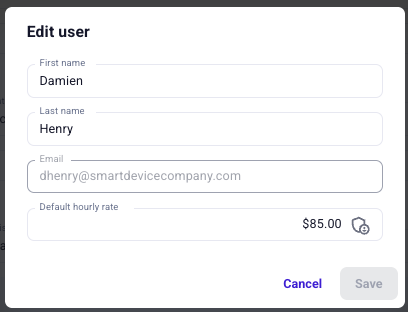
Administrators can **edit user details** directly from the user management interface without navigating to individual user profiles. This includes updating:
* **Personal information** - First name, last name, and contact details
* **Account settings** - Email address and user rate information
To edit a user's information, click "Edit user details" next to the user's name in the user list. Changes take effect immediately.
#### Changing user status
* **Activate user.** This option appears for deactivated users. It sets them `active` in the organization. An active user is a regular user account — they can log in, access and perform all operations in Hardfin that they have permissions for, and receive notifications.
* **Deactivate user.** This option appears for active users. It sets them `deactivated` in the organization. A deactivated user cannot log in, perform any action, or receive notifications.
#### Changing user role
* **Make admin (promote).** This option appears for non-administrator users. It sets them as `admin` in the organization. An admin user is a superuser account — they can deactivate other users and promote/demote other user to and from admin.
* **Remove admin (demote).** This option appears for administrator users. It sets them as `user` in the organization. A user is a regular account — they cannot change other users.
{% hint style="info" %}
In order to avoid locking out your organization, admins cannot make changes to *their own* user account. For example: an admin cannot deactivate their own account or remove their own admin status.
{% endhint %}
#### Setting default rates
Admin can configure **default rates** that automatically apply to users when recording time tracking activities. This ensures consistent pricing across projects and reduces manual rate entry. It can also reduce errors.
Default rates are configured for each user as part of that user's settings:
User settings and rate
These rates are populated automatically user whenever a user logs time.
{% hint style="info" %}
**Only users with `Admin` permissions can see rate information.** Admins can set rates for users, even if that user is not an admin and cannot see their own rate. If a user has a default rate set and cannot see rates, their default rate will always be used when they log time. If a user has a default rate set and has access to rate information, their default rate will be pre-populated when they log time, and the user will be able to modify it as needed.
{% endhint %}